03.03.24
Case Study
At HKR, we approach each project as a collaboration—built on trust, transparency, and shared ambition. The Hounslow West Masterplan is a clear reflection of that ethos.
Early on, HKR identified the site behind Hounslow West Station—owned by Transport for London—as a key opportunity for residentialled regeneration. With TFL committed to delivering 50% affordable housing in line with the Mayor of London’s targets, we brokered a partnership with A2 Dominion, a housing association with a strong record in delivering high-quality, affordable homes. The project later secured funding through the Greater London Authority’s Affordable Homes Programme. The result is a development shaped by aligned values that are responsive to community needs and made possible through strategic collaboration.
Appointed by A2 Dominion in 2019, HKR approached the Hounslow West Masterplan with a deep understanding of the project’s complexity, balancing commercial viability, community needs, and long-term legacy. The site sits adjacent to the Grade II-listed Hounslow West Underground Station, a notable work by Charles Holden, whose architectural legacy is woven into the fabric of London’s transport system. South of the site, protected views to the Cavalry Barracks introduced further contextual interest, deeply valued by the local community.

Previous design proposals had been unsuccessful, hindered by overdevelopment that compromised the site’s character by focusing only on project viability and site optimisation. HKR’s challenge and opportunity was to create a scheme that worked with these constraints rather than against them by collaborating with the local, community, the planners, and other stakeholders. The result is a considered design that honours the station’s heritage, improves local infrastructure, and supports economic and social growth.
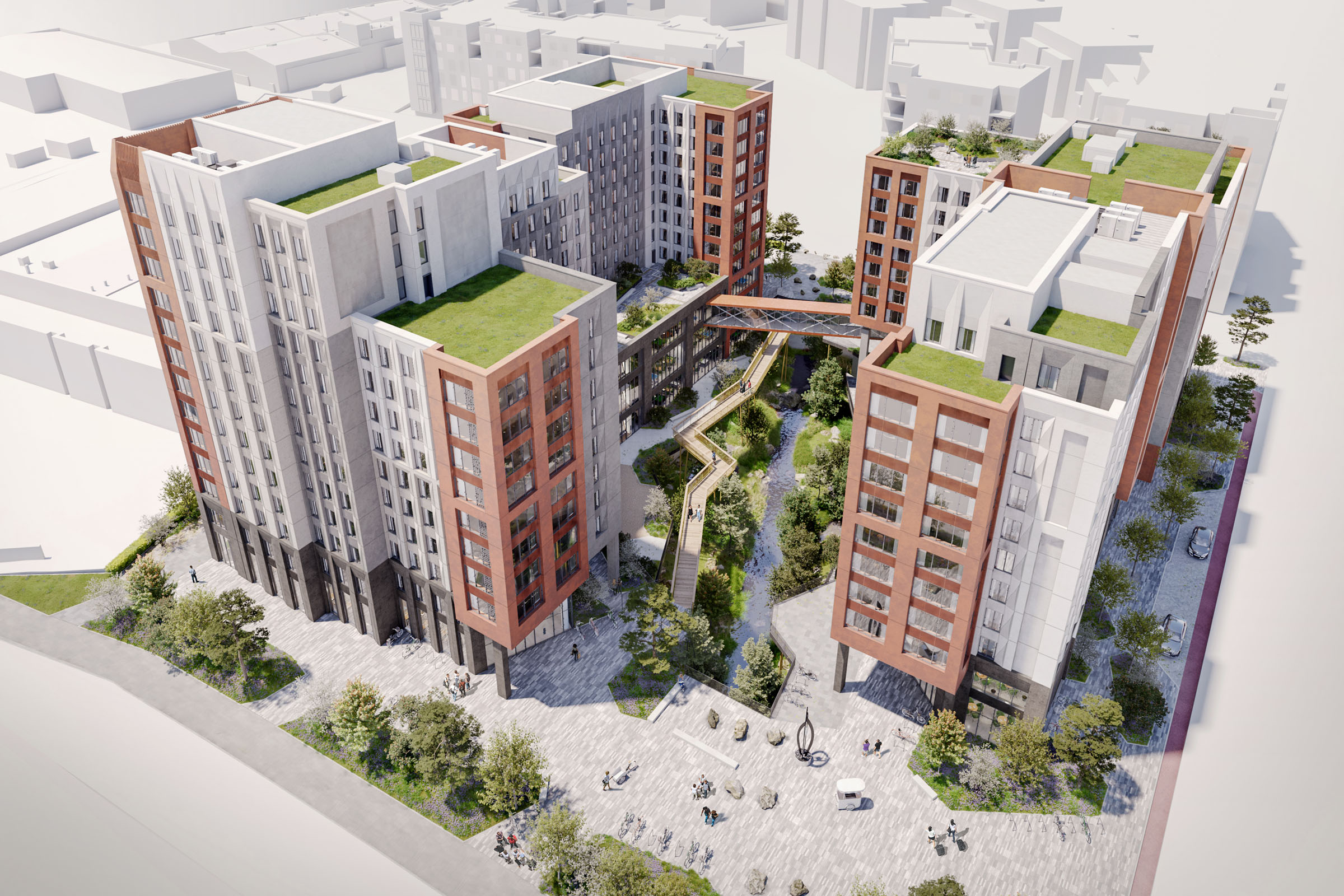
The masterplan delivers 348 new homes across four buildings, ranging from 7 to 12 storeys. It preserves and enhances the listed station, introduces nearly 900 sqm of flexible commercial and community-use space (Use Class E and F), and delivers a revitalised public realm. Enhancements to the SINC, improved transportation connections, and carefully integrated parking and service areas round out a scheme that is respectful, ambitious, and enduring.


Hounslow West Masterplan Site Context and Heritage
Nestled just north of Bath Road, the 1.5-hectare site is currently home to Hounslow West Underground Station and its surrounding infrastructure. The site comprises two disused commercial units flanking the station, a pedestrian walkway, a 419-space car park, EV charging points, a bus stop and stand, and a Site of Importance for Nature Conservation (SINC). Recognised by the London Borough of Hounslow as a prime location for large-scale residential development, the site sits at the threshold between the city’s past and its evolving future.
At the heart of the site stands the Grade II-listed Hounslow West Station, a quietly iconic structure rich with architectural legacy. Originally opened in 1884, the current building was constructed in 1930–31 by Charles Holden in collaboration with Stanley Heaps, in a style reminiscent of Holden’s designs for the 1926 Morden extensions of the City and South London Railway. The single-storey station is clad in Portland stone and crowned by a striking heptagonal ticket hall, framed by glazed screens that flood the interior with natural light.

Just south of the Hounslow West Masterplan lies the Cavalry Barracks—a historic military site that has shaped the identity of the area for over two centuries. Established in 1793 amid fears of French invasion, it became one of the first permanent inland barracks in England. The barracks’ formal layout, with its parade ground flanked by long stable blocks and officers’ quarters, remains largely intact, making it one of the most complete examples of its kind in the country.
The site is framed by a mixture of residential streets to the north, east and west, while Bath Road to the south offers a more urban edge with retail units and serves as a key artery into central London. This juxtaposition of heritage, infrastructure, and community offers a unique foundation for thoughtful, place-led regeneration.
A Sensitive Response to Context and Legacy
The design responds to a series of spatial and technical constraints that divide the site into three development parcels and inform the height and placement of buildings. The first constraint is the listed station building, including the overground tunnel linking the ticket hall to the underground platform, which naturally splits the site into two parcels. The second is the TfL underground tunnel and its 3-metre exclusion zone, which prohibits any construction above due to structural weight limits. Running east–west, this tunnel defines a third, northern development parcel. Additional underground conditions include shallow service routes and their associated exclusion zones along the western boundary, and a 3-metrediameter Thames Water shaft at the southwest corner of the site.
Context and Plan


A further layer of design complexity comes from above: the Heathrow Type A Surface Constraint, which limits building heights to 62.9 metres—approximately 12 storeys—due to the site’s location beneath active flight paths. In addition, protected views towards the historic Cavalry Barracks, located south of the site, restrict height and orientation in specific locations. These long-valued sightlines reflect the community’s connection to the area’s heritage and help shape the massing strategy.
Beyond technical boundaries, the concept is grounded in balancing infrastructure, public life, and housing need. As Hounslow West continues to evolve, the site is positioned as a key civic node—supporting the borough’s vision while delivering meaningful residential density.
The masterplan provides 348 new homes, all 100% affordable. Of these, 62% are allocated to London Affordable Rent (Blocks A, B, and D), with 38% set for Shared Ownership (Block C). The development includes a full housing mix—from one- to four-bedroom units—with 10% designed for full wheelchair accessibility.


The scheme’s massing is carefully calibrated to respect the Grade II Listed Station and surrounding residential context. Building height is concentrated toward the centre of the site, with Blocks B and C peaking at 12 storeys. From this core, the mass steps down progressively, with the north wing of Block D reaching a modest three storeys to align with neighbouring homes. Block B features chamfered forms that echo the heptagonal geometry of the station building, sitting back respectfully to frame the station as the architectural jewel of the site. Setbacks at the Ground and Mezzanine levels of Blocks B and D further preserve the station’s prominence while enriching the pedestrian experience at street level. Similar chamfering in Blocks C and D frames the Green Link and public realm, creating a more open and welcoming arrival space. Meanwhile, Block A follows the natural curvature of Vicarage Road, tying the development into its streetscape context.

Façade Design
The façade design draws on a carefully curated material palette to break down the massing and create moments of architectural clarity. Grey and light brick are used in deliberate contrast—grey anchoring the buildings to the ground, while lighter tones lift the upper levels, softening their presence against the sky and the neighbouring homes. This contrast not only tempers the scale but also brings depth and movement to the elevations.
Green glazed brick marks out key thresholds, highlighting residential entrances and commercial frontages with a subtle vibrancy. Red-glazed brick animates the balcony recesses of Block C, lending richness and texture. Bronze-toned panels frame inset balconies throughout, adding a layer of refinement that catches the light and enriches the streetscape. The overall effect is one of tactility, rhythm, and human scale—responding to context while confidently expressing the identity of the scheme.
Material Reference Images


Landscape Design
The landscape masterplan unfolds as a tapestry of interconnected spaces—1,450 sqm of pedestrian-priority streets, vibrant squares, and serene courtyards. Character zones range from animated gathering lawns to intimate pockets for quiet reflection, play, and social exchange. Residential courtyards integrate playful, engaging playgrounds—spaces where children can safely explore, interact, and unwind within a welcoming landscape.
Green Street
A new Green Link stitches Beaversfield Park to the Site of Importance for Nature Conservation (SINC), anchoring the public realm. Blocks B, C, and D frame this green corridor with active edges, retail, café terraces, and flexible community spaces surrounding a lively public square. A “green street” carves a shaded pedestrian route from the station to Ambassador Close, reinforcing permeability and creating a sense of place.
Housing Quality and Affordability
348 affordable homes are meticulously crafted for wellbeing and adaptability. All units exceed London Plan space standards and Part M accessibility requirements, with 10% fully wheelchair-accessible and 90% designed to be adaptable. Seventy-three percent are dual-aspect, optimising natural light and cross-ventilation; single-aspect homes are purposefully placed to frame expansive public-realm views while avoiding any north-facing exposure—enhancing spatial quality and everyday experience.
Every home is afforded private outdoor amenity. For units on the ground floor, this is provided in the form of private gardens with access gates, which exceed policy requirements, while units on upper levels are provided with balconies.

Station Design
The renewal of Hounslow West Station unfolds as both a gesture of care and ambition. A new elevated walkway replaces the existing link to the platform, accompanied by a quiet extension at the rear—providing spaces for operational and staff needs, thoughtfully tucked from view.
Cycle parking is reimagined, moved from Bath Road to a secure, purpose-built facility nestled along a newly formed pedestrian boulevard. Along this green artery, the station’s new façade comes alive—its rhythm redefined with generous glazing that invites light in and welcomes travellers with openness and security. Subtle brick recesses lend depth and elegance, celebrating the building’s historic fabric with contemporary restraint.
To foster a safer, more intuitive public realm, the existing bus stop, once positioned directly before the station entrance, will be relocated to Bath Road. This subtle shift enables the station forecourt road to be locally narrowed, in turn unlocking space for a significantly widened footway.

Sustainability
The proposal embraces the future of sustainable living, aligning with the Net Zero goals set by the London Borough of Hounslow and the GLA, while honouring the principles of TfL’s Sustainable Development Framework. At its core, the development adopts an all-electric energy strategy, harnessing the efficiency of air-source heat pumps to power the site.
A green ethos permeates the design—pedestrian-friendly streets take precedence, inviting active transport while reducing reliance on vehicles. Landscaped courtyards, verdant green roofs, converge to form a dynamic ecosystem, enhancing air quality, supporting biodiversity, and managing rainwater through Sustainable Urban Drainage Systems (SUDS). These elements are not merely functional; they weave nature into the very fabric of the site.
Through this sustainable architecture, the project achieves a BREEAM ‘Very Good’ rating and a 4-star HQM Rating, ensuring that each design decision contributes to a healthier, greener, and more resilient environment.
Technical
The design is supported by a thorough suite of technical analyses, guaranteeing that every detail contributes to the comfort and well-being of future residents. Various analyses—such as those focused on daylight and sunlight, wind, noise, overheating, air quality, and ecology—have been taken into account to ensure the scheme offers occupant comfort, liveability, and environmental quality, while also complying with regulatory standards.